
Evaluation & Treatment
Night Guard vs. Sleep Apnea Appliance: What's the Difference?
Published 7 min read
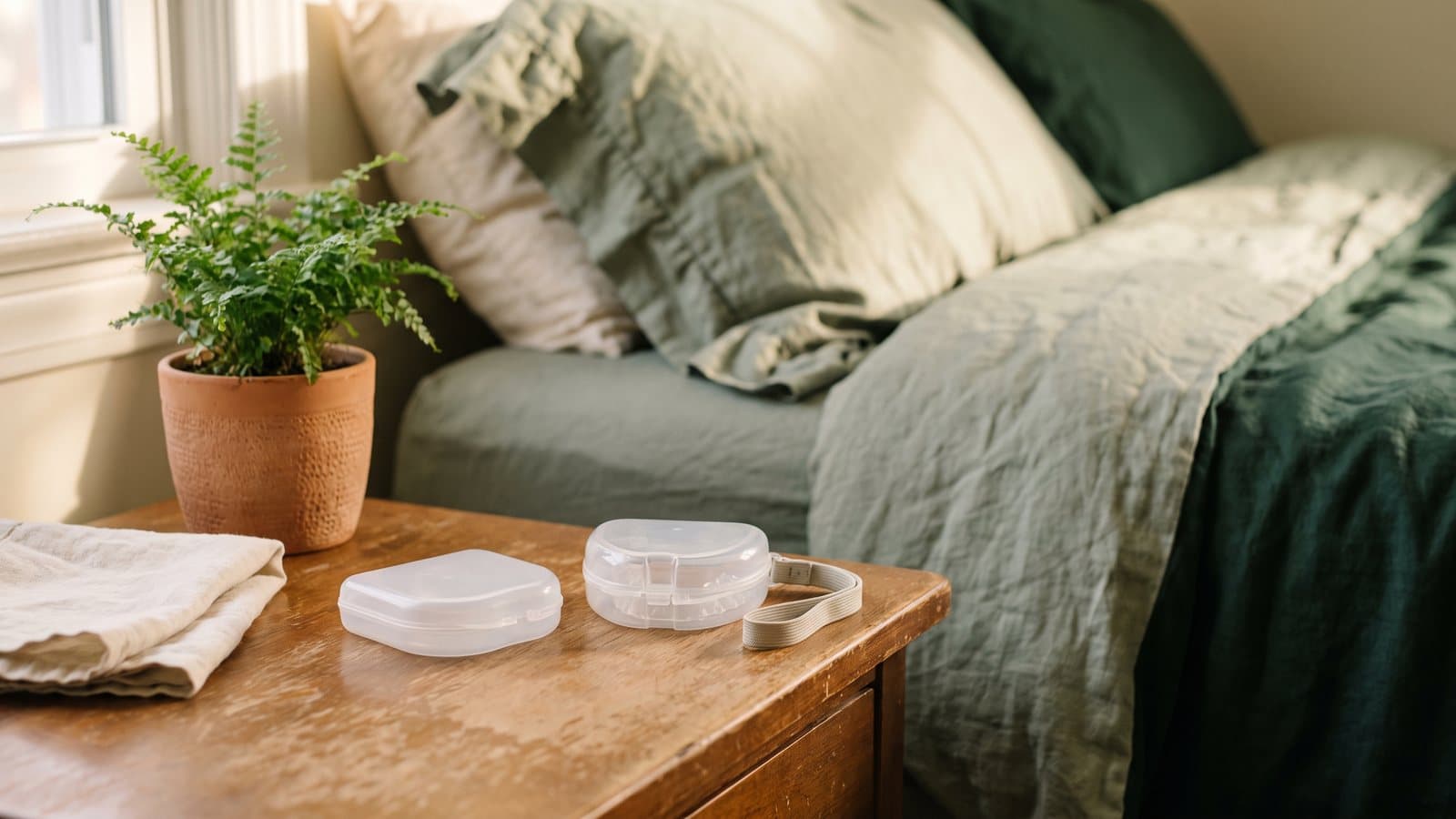
The Night Guard in Your Drawer Might Not Be a Sleep Apnea Appliance
You reach into the nightstand drawer for the clear plastic guard your dentist made a few years ago, back when grinding was wearing down your molars. Since then, a partner has mentioned you snore, or a doctor has raised the word sleep apnea, and you wonder if the same guard covers both problems.
It is a reasonable question, because the two devices can look almost identical: a molded piece of plastic that fits over your teeth at night. What they are built to do, though, is different, and mixing them up can leave either your teeth or your airway without the support they actually need.
Austin Sleep & Airway Health sees this mix-up often. This guide compares a standard night guard with a sleep apnea appliance, what current research says about wearing the wrong one, and how an airway evaluation helps you land on the right fit.
What a Standard Night Guard Protects
A standard night guard, sometimes called an occlusal guard or bite splint, is built for one job: protecting your teeth. It creates a barrier between your upper and lower teeth so that grinding or clenching, called bruxism, wears down the plastic instead of your enamel.
Most standard guards use a flat, even surface and hold your bite in a fairly neutral position rather than move your jaw forward. Dentists often recommend one after noticing flattened or chipped teeth, jaw muscle soreness, or teeth grinding at night that a partner has pointed out.
A night guard can ease jaw tension and slow tooth wear. On its own, though, it is not built or tested to keep your airway open, and it is not a treatment for snoring or sleep apnea.
What a Sleep Apnea Appliance Is Designed to Do
A sleep apnea appliance, most often a mandibular advancement device, works toward a different goal: supporting your airway while you sleep. It holds your lower jaw slightly forward, which helps keep the tongue and surrounding tissue from collapsing back and narrowing the airway overnight.
At Austin Sleep & Airway Health, building one starts with custom impressions or digital scans of your teeth, not a flat mold. A dental lab fabricates the appliance to your bite, then we fit it and adjust the jaw position gradually over follow up visits, a process called titration. A follow up sleep test, coordinated with your physician, confirms how well it is working.
Oral appliance therapy is prescribed for snoring and diagnosed obstructive sleep apnea, and it is one option alongside CPAP, not a replacement decided without a physician's diagnosis.
Why the Difference Matters: Protecting Teeth vs. Supporting the Airway
Here is the simplest way to hold the two apart. A standard night guard protects your teeth from the force of grinding. A mandibular advancement device is designed to support your airway by repositioning your jaw.
Both sit over your teeth, and both are made of similar plastic, so it is easy to assume one does the job of the other. Wear a flat night guard hoping it also helps with snoring, and your airway may get no real support. Wear a jaw advancing appliance without a proper fitting, and you could still be missing the tooth protection you need.
The fix is not guessing. It is an airway focused exam that identifies which problem, or both, you are dealing with.
Can a Night Guard Affect Your Breathing?
Here the research is worth knowing, and it is not a reason for alarm. A small, peer reviewed study in the Journal of Oral & Facial Pain and Headache tested a standard flat stabilization splint, the kind used mainly for grinding, in adults with obstructive sleep apnea. On nights participants wore the splint, breathing related events during sleep increased slightly compared with nights without it, though the researchers were careful to note the change was modest and unlikely to matter clinically for most people.
That finding is not a reason to fear a night guard. It does mean a flat night guard is not built to help sleep apnea, and in some people it may not be entirely neutral either, which is one reason an airway evaluation matters before you decide what to wear at night, especially once snoring or sleep apnea is part of the picture.
What to Track Before You Decide
You do not need a diagnosis to start noticing patterns. For a week or two, keep a simple log by the bed: how often you grind or clench, whether you wake with jaw soreness or a headache, and whether a partner mentions snoring, gasping, or pauses in your breathing.
Also note whether your current night guard fits well, stays in place, or feels loose by morning, since that tells Dr. Culotta whether tooth protection or something more is the real issue. Keeping a simple sleep log before your evaluation gives her more to work with than a general sense that something is off.
Bring the log, and the guard itself if you already have one, to your visit.
When It's Worth an Airway Evaluation
A few signs point toward scheduling a visit rather than continuing to guess. If grinding continues despite a well fitted guard, if your jaw stays sore, or if snoring has become part of your nightly routine, that is worth a look.
Pay closer attention if a partner describes gasping, choking, or pauses in your breathing, not just noise. That is worth mentioning to your physician, since only a physician diagnoses sleep apnea, through a home sleep test or an in-lab sleep study.
You do not need to wait for a crisis. An evaluation is reasonable any time you are unsure whether the device in your drawer is doing what you actually need it to do.
How Austin Sleep & Airway Health Helps With Night Guards and Sleep Apnea Appliances
Austin Sleep & Airway Health, in the Mueller area of Austin, is the dental sleep and airway practice of Dr. Kacie Culotta, DMD, a Diplomate of the American Board of Dental Sleep Medicine and a Qualified Dentist with the American Academy of Dental Sleep Medicine. Patients often arrive with an old flat guard in hand, unsure whether it is doing enough.
We start with an airway focused exam: tongue mobility and posture, palate width, bite, jaw joints, tonsil size, and whether you breathe through your nose or mouth at night. When useful, in-house CBCT airway imaging adds a closer look at airway shape, volume, and structures such as the tonsils, adenoids, and jaw position, in about 45 seconds at a low dose. From there, Dr. Culotta recommends a standard night guard, a custom sleep apnea appliance, or both, and coordinates with your sleep physician when testing is part of the picture.
Dr. Culotta often says, "It's never too late to breathe, sleep, and feel better." That applies whether you are protecting your teeth, supporting your airway, or finally finding out which one you actually need.
Frequently Asked Questions
What's the difference between a night guard and a sleep apnea appliance?
A standard night guard protects your teeth from the force of grinding, while a sleep apnea appliance is designed to reposition your jaw and support your airway. The two can look similar, but a night guard is not built or tested to treat snoring or sleep apnea.
Can I keep wearing my old night guard if I've been told I might have sleep apnea?
A night guard alone is not enough if sleep apnea is a possibility, since it protects your teeth but is not designed to support your airway. It is reasonable to keep wearing it for grinding while you schedule an airway evaluation to find out what else you need.
Can a night guard make sleep apnea worse?
Some research suggests a standard flat night guard may affect breathing slightly in certain people with sleep apnea, though the change measured was small. This is one reason it is worth mentioning any snoring or breathing concerns before your dentist makes a guard, so the right device gets matched to the right problem.
How do I know if I need a mandibular advancement device instead of a standard night guard?
The clearest way to know is an airway focused exam that looks at your bite, jaw, tongue posture, and breathing patterns alongside any grinding. Dr. Culotta can tell you whether tooth protection, airway support, or both are the right path after that evaluation.
Does insurance cover a sleep apnea appliance the way it covers a night guard?
Coverage for a sleep apnea appliance usually depends on a physician's diagnosis and your insurance plan, and it typically differs from how a standard night guard is billed. Ask our team what documentation your evaluation and any sleep study provide, since that paperwork often matters for reimbursement either way.
Where can I get evaluated for a night guard or sleep apnea appliance in Austin?
Austin Sleep & Airway Health, in the Mueller area of Austin, evaluates patients for both standard night guards and custom sleep apnea appliances after a full airway exam. Call (512) 900-9715 to schedule, or start with our sleep apnea appliance page.
Ready to Find Out Which Device Is Right for You?
If the guard in your drawer is not doing the job you need it to, whether that is protecting your teeth or supporting your airway, an evaluation is a reasonable next step. Visit our sleep apnea appliance page to see how the process works, or call (512) 900-9715 to schedule with Austin Sleep & Airway Health.
By Austin Sleep & Airway Health
This article is for general education. It is not a diagnosis and does not replace an evaluation with a qualified provider.
A comfortable option worth exploring
Learn how a custom oral appliance gently supports an open airway during sleep, and how we work alongside your sleep physician.
Keep Reading
Related articles

Evaluation & Treatment
Sleep Study Results Explained: AHI, Oxygen, and Next Steps
Your sleep study results are in. Here is what AHI, RDI, ODI, and your oxygen numbers actually mean, and what to ask your physician about next steps.
Read more7 min read
Evaluation & Treatment
Is a CBCT Scan Safe? Radiation and Airway Imaging Explained
See how much radiation a CBCT scan uses, how the ALARA principle keeps every scan low, and what Dr. Culotta looks for during your airway evaluation.
Read more7 min read
Evaluation & Treatment
Laser Snoring Treatment: What Soft Palate Tightening Involves
A calm guide to laser snoring treatment: how soft palate tightening works, what research shows, and how candidacy is decided at a consultation.
Read more7 min read
Free Sleep Apnea Quiz
Do You Have Sleep Apnea? Find Out Now
Snoring, fatigue, and restless nights could be signs of sleep apnea, a condition that affects your health more than you might realize. Take our quick, easy Sleep Apnea Quiz to uncover potential risk factors and determine if it’s time to seek expert care. In just a few minutes, you’ll gain valuable insights into your sleep health and take the first step toward better breathing, restful nights, and a healthier life. Don’t wait. Your journey to better sleep starts here!